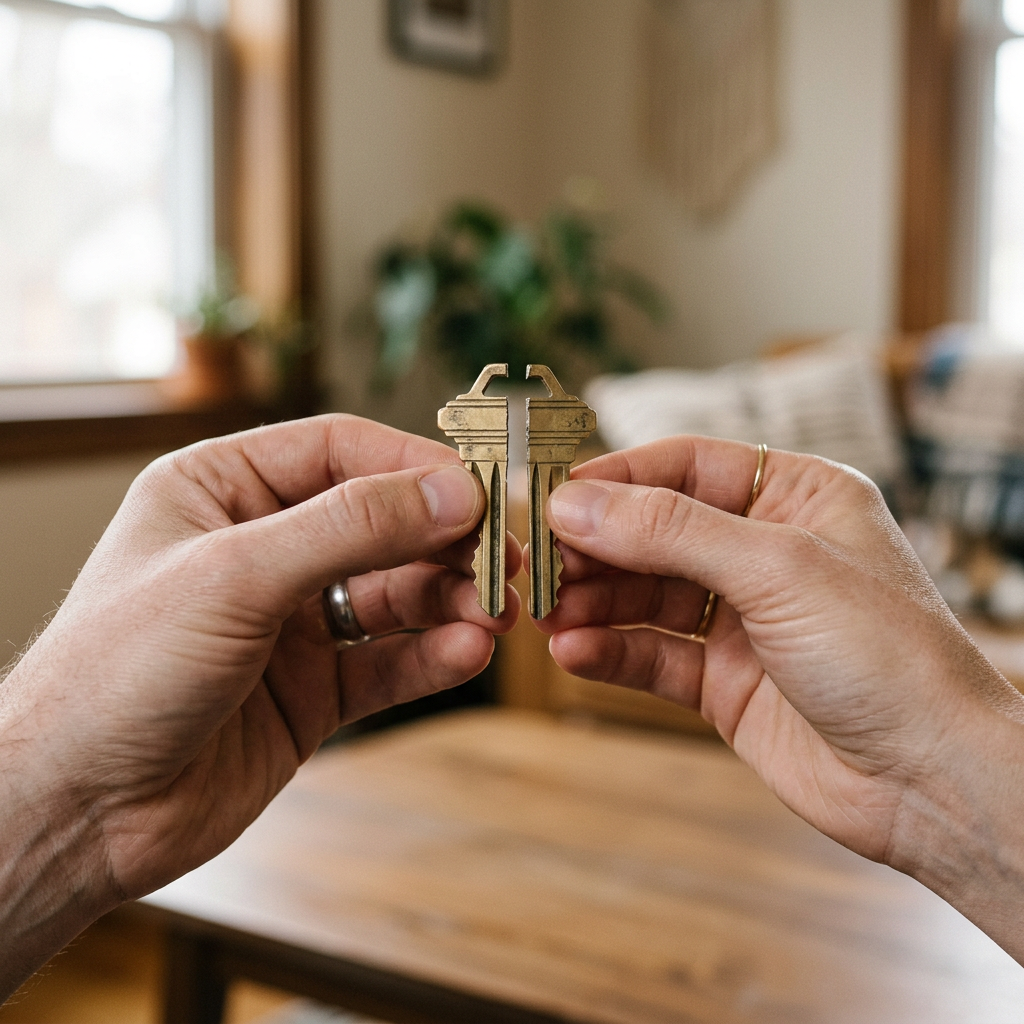
Two brothers bought a duplex together in their thirties, each putting up half the down payment, and never thought about the paperwork again for twenty years. When one of them died unexpectedly, his half didn’t go to his wife, his kids, or the estate his will described in careful detail. It went straight to his brother. Not because the will was wrong. Because the deed, filled out decades earlier by a title company clerk who was just following a template, had quietly made that decision for him the day they bought the place.
The two ways of co-owning property look almost identical on paper. They are not almost identical in what happens when one owner dies.
The one word that changes everything
Joint tenancy carries a right of survivorship: when one joint tenant dies, their share doesn’t pass through their will, their trust, or their estate at all — it passes automatically and immediately to the surviving joint tenant, by operation of law. California’s civil code states the mechanics plainly: a joint interest is one owned by two or more people in equal shares, created by a single transfer, expressly declared as a joint tenancy.¹ That word “expressly” matters — most states presume tenancy in common unless the deed specifically states joint tenancy with right of survivorship, so the deed’s exact language is doing all the legal work here, not the parties’ assumptions about what they meant.
Tenancy in common has no survivorship feature at all. Each owner’s share is treated as their own separate property, passing at death exactly like any other asset they own individually — through their will, through intestate succession if they have no will, or into their trust if it was held that way. A tenant in common’s share can also be unequal: two people can hold 70% and 30% of the same property, something joint tenancy generally doesn’t allow, since joint tenancy requires equal shares by definition.¹
Why the difference is bigger than it sounds
Under joint tenancy, your will has no power over your share of that property, no matter what it says. This is the same override problem that shows up with beneficiary designations on a 401(k) — a will only controls what’s actually in your individual name, and jointly-titled property with survivorship rights was never in your individual name to begin with. If you want your share of a jointly-owned house to go to your children instead of your co-owner, joint tenancy is structurally incapable of doing that. You’d need tenancy in common, or you’d need to retitle the asset before you die.
The two structures also diverge sharply on what happens while everyone’s still alive and one owner wants out. Under tenancy in common, any co-owner — even one holding a minority share — generally has the right to file a partition action, asking a court to either physically divide the property or force its sale so the proceeds can be split.² You cannot be permanently trapped as an unwilling co-owner with someone you no longer want to own property with; the law gives you an exit, even an unpleasant one. Joint tenancy has a different escape valve: any joint tenant can unilaterally sever the joint tenancy — often just by transferring their interest to themselves — which converts it into a tenancy in common and destroys the survivorship right going forward, without needing the other owner’s agreement.³
The scenario people don’t plan for
Blended families run into this constantly, usually without realizing it until it’s too late to fix. A remarried homeowner who adds a new spouse to the deed as a joint tenant — a routine, well-intentioned move — has just guaranteed that the house passes entirely to that spouse at death, bypassing children from a first marriage completely, regardless of anything the homeowner’s will says about wanting the kids to eventually inherit the property. That’s not a loophole or an edge case. It’s the joint tenancy mechanism working exactly as designed. The mismatch is between what the deed does and what the owner assumed a will would still control.
Which one you actually want
Neither structure is objectively better — they’re built for different intentions. Joint tenancy suits people who genuinely want the survivor to take everything automatically, without probate, and who are comfortable that the arrangement overrides anything written elsewhere. Tenancy in common suits people who want their share to go where their estate plan says it should go, who hold unequal contributions to the property, or who want the option to force a resolution if the co-ownership stops working. The two brothers in the opening story never had that conversation — they just accepted whatever a form said by default. Checking which one is actually on your deed takes fifteen minutes and a county recorder’s website. Finding out the hard way takes considerably longer.
Sources
1. California Civil Code §683(a) — joint interest defined as equal shares, created by a single transfer, expressly declared as joint tenancy; absent that express declaration, tenancy in common is presumed in most states.
2. Texas Property Code, Chapter 23A, Uniform Partition of Heirs’ Property Act — governs partition actions among co-owners; general common-law partition right for tenants in common recognized across states, with specific procedures varying by state.
3. General common-law principle recognized across U.S. jurisdictions: a joint tenant may unilaterally sever a joint tenancy (e.g., by conveying their interest), converting the arrangement to a tenancy in common and terminating the right of survivorship as to that share. Confirm the specific mechanism and required formalities in your state.
This article is for educational purposes only and does not constitute legal, tax, or financial advice. Property co-ownership rules, default presumptions, and partition procedures vary by state; consult a licensed real estate or estate planning attorney about your specific deed.